
The Bowl That Taught Me to Miss Home
In Thailand, Tom Kha Gai isn’t really a soup, the way everyone thinks of soup. You don’t sit down to a bowl of it as a starter before the main event. It arrives at the table alongside rice, a stir-fry, maybe a salad — it’s part of the spread, a main dish in its own right. Lighter than a curry, richer than a broth, it lives somewhere beautifully in between. The coconut milk gives it body, the galangal gives it that sharp, almost medicinal warmth, and the lemongrass lifts everything with a citrus note that feels almost floral. When it’s good, it’s deeply good.
Growing up, my parents kept a small patch of herbs just outside the kitchen door. Nothing elaborate — just what we needed. Lime trees, kaffir lime leaves, lemongrass, chilli, and a few things that moved in and out depending on the season. I never really thought about it. I’d be sent out to grab a few stalks of lemongrass or a handful of kaffir lime leaves and I’d just do it, pinch them off and come back inside. The smell on your fingers after breaking a kaffir lime leaf — that sharp, waxy, intensely green fragrance — I didn’t know that was a luxury until I moved to Europe and had to hunt for a tiny, overpriced packet of dried leaves in a Thai grocery tucked in the back of a market.
The first time I made Tom Kha Gai in my tiny London apartment, I was genuinely proud of myself. I’d tracked down fresh galangal, found some lemongrass at a small Asian shop near Brixton, and spent a Sunday afternoon building the broth slowly. The kitchen smelled incredible — warm and herbal and familiar in a way that made my chest ache a little. But when I tasted it? It was fine. It was okay. It wasn’t bad. But it wasn’t right either. Something was flat. I couldn’t name it immediately, but I knew. That absence of something you can’t quite put a finger on is the hardest thing to fix when you’re cooking far from home.
Still Struggling to Stay on Keto Because You Miss Desserts?
There’s a dessert cookbook made specifically for the keto diet — with 100+ recipes for chocolate cake, cookies, ice cream, and more. Zero sugar. Low carb. Stay in ketosis. And it’s only $9.
| → See Keto After 50 Desserts |
Only $9 · Includes 2 Free Bonus Books
+ 60-day money-back guarantee |
*Affiliate link — I may earn a small commission at no extra cost to you.
Over time I figured out what it was — a combination of things, actually. The quality of the herbs, yes, but also the ratios, the order of adding things, and a few small techniques I’d just absorbed from watching my parents without realising I was learning. Now I make it regularly, and it’s become one of my most reliable weeknight dinners. And here’s the good news for anyone eating keto: Tom Kha Gai is one of the most naturally keto-friendly Thai dishes in existence. With a few thoughtful swaps, you can have a bowl that’s rich, fragrant, deeply satisfying — and completely at home in a low-carb lifestyle.
The Keto Transformation — What Changes and What Doesn’t
Let me be honest with you. Traditional Tom Kha Gai is already pretty close to keto. The base — coconut milk, chicken, galangal, lemongrass, kaffir lime leaves, fish sauce — is naturally low in carbohydrates. The aromatics are used for flavour, not eaten in large quantities. The broth itself is fat-forward and protein-rich. So you might be wondering: what’s even the problem?
The issues are small but real. First, many restaurant versions and family recipes add a spoonful of palm sugar to round out the flavour balance. That sweetness matters — Tom Kha without any sweetness can taste sharp and one-dimensional — but palm sugar, with its rich caramel depth, raises the carb count and spikes blood sugar in a way that doesn’t fit a ketogenic approach. Some recipes also include oyster sauce or a Thai seasoning sauce that carries hidden sugar and modified starch. And of course, in Thailand this is always eaten with jasmine rice. The dish itself isn’t the carb load — the rice is. So for a keto version, we’re removing the rice (or replacing it with cauliflower rice), swapping palm sugar for a small amount of a keto-friendly sweetener, and being careful about which fish sauce and seasoning products we use.
What you won’t lose: the aroma. The moment galangal hits warm coconut oil, it releases something that smells ancient and clean at the same time — slightly medicinal, faintly lemony, completely distinct from ginger. You keep that. You keep the broth’s silky texture from full-fat coconut milk. You keep the heat from bird’s eye chillies. You keep the umami depth from fish sauce. The flavour backbone of this dish is fat, salt, aromatics, and acid — and none of that needs to change.
What might feel slightly different: the sweetness is subtler with erythritol. Palm sugar has a caramel note that no low-carb sweetener fully replicates. I won’t pretend otherwise. But in the context of the whole broth, with everything else going on, most people cannot tell once the bowl is in front of them.
Why This Works for Keto
Full-fat coconut milk is the star of this dish from a keto perspective. It’s high in saturated fat, contributes minimal net carbs per serving, and creates a naturally creamy broth without any thickening agents. Chicken thighs — I always use thighs, never breast — add protein and fat in a ratio that works well for keto macros, and the extra fat carries flavour in a way leaner cuts simply don’t. The aromatics — galangal, lemongrass, kaffir lime leaves, chillies — contribute almost no meaningful carbohydrates in the quantities used here.
The one thing to watch is the fish sauce. Most traditional Thai fish sauce is just fermented fish and salt, which is perfectly fine. But some brands add sugar or flavour enhancers — check the label before you buy. For the sweetener, I use a very small amount of erythritol — barely half a teaspoon — just enough to take the sharp edge off without meaningfully affecting the macros. Mushrooms add a small amount of carbs alongside fibre, so the net carb impact per serving stays low. Overall, a generous bowl of this dish sits comfortably within a ketogenic range.
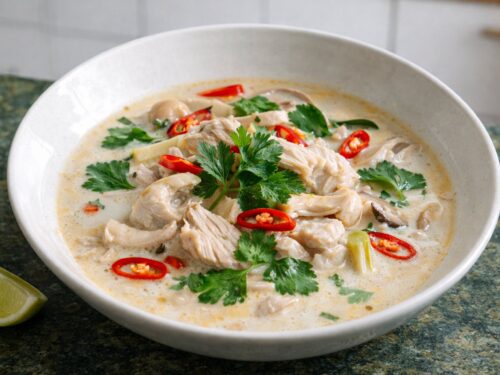
Creamy Galangal Coconut Chicken Soup (Tom Kha Gai)
Print PinIngredients
Main Ingredients
- 500 g boneless chicken thighs cut into bite-sized pieces, skin-on if possible
- 150 g oyster mushrooms or king oyster mushrooms torn by hand into rough pieces
- 400 ml full-fat coconut milk one standard can, must be full-fat
- 200 ml chicken stock homemade or low-sodium carton, no added sugar or starch
Aromatics and Broth
- 4 slices fresh galangal 3–4mm thick, skin on
- 2 stalks lemongrass outer leaves removed, bruised, cut into 4cm pieces
- 6 kaffir lime leaves torn roughly, central stem removed
- 4 bird’s eye chillies bruised, adjust to heat tolerance
- 2 tablespoons fish sauce check label for no added sugar or starch
- 1 tablespoon coconut oil or neutral oil
- 0.5 teaspoon erythritol sweetener keto substitute for palm sugar
- 1 lime juice only, added per bowl at serving, never into the pot
For Serving (Optional)
- fresh coriander leaves roughly torn
- 1 bird’s eye chilli sliced thin for garnish
- cauliflower rice steamed, keto replacement for jasmine rice
- lime wedges extra, for serving
Instructions
Stage 1 — Prepare Your Aromatics
- Peel back the tough outer layers of each lemongrass stalk until you reach the pale, almost translucent inner core. Using the flat of a heavy knife, bash each stalk firmly — you’ll hear a soft crack and immediately smell that clean, citrus-forward fragrance lift into the air. Cut into 4cm lengths.
- Slice the galangal across the grain into thick coins. No need to peel it — the skin holds flavour. You’re infusing through these pieces, not eating them, so don’t worry about how they look.
- Take your kaffir lime leaves and tear each one roughly down the middle, pulling away the thick central stem. Tearing rather than cutting opens up more surface area and releases more of the waxy, sharp oil locked inside the leaf.
- Bruise the bird’s eye chillies by pressing the flat of a knife firmly down on each one — just enough to split them slightly without scattering all the seeds. You want the heat to bleed slowly into the broth, not explode into it.
Stage 2 — Build the Broth Base
- Heat a medium heavy-bottomed saucepan over medium heat. Add the coconut oil. When it shimmers — warm but not smoking — add the galangal slices. They should sizzle gently. Let them toast for about 30 seconds until the pan starts to smell faintly medicinal and warm.
- Add the lemongrass pieces and torn kaffir lime leaves. Stir gently and cook together for another 30–40 seconds, allowing the aromas to layer — galangal’s sharp citrus note underneath, kaffir lime’s more floral fragrance on top.
- Pour in the chicken stock first, then the coconut milk. The broth will transform from pale and thin into a rich, milky gold as the coconut milk fully incorporates. Turn the heat to medium-low.
- Add the bruised chillies. Let the broth simmer gently — small, lazy bubbles at the edge of the pan — for 10 minutes, allowing the aromatics to fully infuse. Do not let it boil aggressively. Coconut milk splits at high heat and becomes grainy and oily. Keep it calm.
Stage 3 — Cook the Chicken and Mushrooms
- Add the chicken pieces to the simmering broth. They should be mostly submerged. Keep the heat at medium-low and cook for 8–10 minutes. The chicken is done when it feels just firm under gentle pressure from a spoon — not hard, not giving. If unsure, cut a thick piece open — it should be white all the way through with no pink remaining.
- Add the torn mushrooms. They need only 3–4 minutes. Oyster mushrooms will soften quickly and soak up the broth — watch their edges shift from pale cream to a deeper, slightly golden colour as they cook through.
- Season with fish sauce, adding it gradually and tasting after each addition. The broth should taste salty first, then rich, then the warmth from the galangal and chilli builds slowly at the back of your throat. Add the erythritol now, stirring gently to dissolve. Taste and adjust — if the broth feels flat or dull, the answer is almost always a little more fish sauce.
Stage 4 — Serve Properly
- Ladle the soup into bowls. Remove the galangal, lemongrass, and kaffir lime leaves as you serve — or leave them in as visual decoration, but warn anyone at the table not to eat them. They are flavouring tools, not food.
- Add fresh coriander and sliced chilli on top. Squeeze lime juice directly into each bowl at the table — never into the pot. Acid added to hot coconut milk causes it to curdle and turn grainy. Added at the last moment into an individual bowl, the lime gives a bright, sharp lift that cuts through the richness cleanly.
- If serving with cauliflower rice, place the cauliflower rice in the bowl first and ladle the hot broth over it. It absorbs the broth beautifully, almost exactly the way jasmine rice would.
Notes
Ingredient Notes
- Netherlands: Fresh galangal and lemongrass at Toko, Amazing Oriental, or Albert Heijn XL in larger cities. Kaffir lime leaves are sometimes in the AH XL frozen section.
- UK: Fresh galangal at Wing Yip, Waitrose, or larger Sainsbury’s branches. Kaffir lime leaves at most Asian supermarkets in London, Manchester, and Birmingham.
- Germany: Asian Food Markt and Go Asia (nationwide chain) — reliable for galangal and lemongrass. Kaufland sometimes stocks fresh lemongrass.
- France: Tang Frères in Paris is your best bet. Larger Carrefour stores in cities sometimes carry fresh lemongrass.
Hard-to-Find Ingredients
Galangal
This is the one ingredient that truly cannot be replaced without fundamentally changing the dish. Galangal and ginger look similar but taste completely different — galangal is sharper, more citrusy, almost piney and medicinal. Ginger gives you a different dish entirely. That said, if you genuinely cannot find galangal, a combination of fresh ginger and a small piece of fresh turmeric is closer than ginger alone — though I want to be clear, it still won’t taste the same. In the Netherlands, Amazing Oriental usually stocks fresh galangal. In the UK, Wing Yip is the most reliable option nationwide.
Kaffir Lime Leaves
Often found frozen in Asian grocery stores across Europe. Frozen works well for cooking — the flavour is largely preserved through freezing. Dried kaffir lime leaves are also available but noticeably less fragrant. If you must use dried, double the quantity and accept a flatter result. In the Netherlands, toko shops (Indonesian-influenced grocery stores) are a reliable source for frozen kaffir lime leaves. In Germany, Go Asia stores carry them consistently.
Fish Sauce
Squid, Tiparos and Megachef are all reliable brands available across European and Asian supermarkets. Avoid supermarket own-brand fish sauce if you can — quality varies significantly, and added ingredients are common. Megachef, in particular, has a cleaner flavour and a short ingredient list. Always check the label for added sugar or starch thickeners.
Bird’s Eye Chillies
Often sold frozen in European Asian supermarkets — frozen bird’s eye chillies work just as well as fresh for this dish. In a pinch, fresh red or green finger chillies from a mainstream supermarket will work, though they’re considerably milder. Adjust the quantity accordingly and expect less heat.
Common Mistakes and How to Fix Them
- Boiling the coconut milk too aggressively. Coconut milk splits at high heat, turning from silky and creamy to grainy and oily with fat pooling on the surface. Always keep it at a gentle simmer — small bubbles at the edges, never a rolling boil. If it does split, lower the heat immediately and whisk in a tablespoon of cold water to try to bring it back.
- Adding lime juice to the hot pot. Acid reacts with coconut milk under heat and causes it to curdle. You end up with a lumpy, unappetising liquid. Always add lime at the table, per bowl, at the last moment.
- Using ginger instead of galangal. If a recipe tells you these are interchangeable, that recipe is not trying hard enough. They taste completely different. Use galangal wherever you can find it.
- Under-seasoning with fish sauce. Fish sauce is the salt of Thai cooking. If the broth tastes flat or dull, the answer is almost always more fish sauce. Add incrementally, tasting as you go — it should taste assertively savoury before the lime lifts it.
- Cutting kaffir lime leaves instead of tearing them. Cutting gives you neat strips. Tearing opens up the cells in the leaf and releases more essential oil. Tear them with your hands — rough and uneven is fine.
- Using light or reduced-fat coconut milk. The fat is what makes this broth feel the way it feels. Light coconut milk produces a thin, watery soup that never develops that beautiful milky gold colour or the silky coating it should leave on the back of a spoon. Use full-fat, always.
Substitution Guide
Coconut Milk
Aroy-D and Chaokoh are the two most trusted brands in Asian supermarkets across Europe, and both are widely available. Look for cans where the ingredient list reads simply: coconut extract, water. Nothing else. Avoid brands with significant added thickeners if you can, though a small amount of guar gum is generally fine. Supermarket own-brand coconut milk is acceptable in a pinch, but consistency varies — some are surprisingly watery even in their full-fat versions. Shake the can before opening: you want it thick and barely moving, not sloshy.
Fish Sauce
Megachef is the cleanest option widely available in Europe. Tiparos is reliable and easier to find in smaller Asian shops. Avoid anything labelled “stir fry sauce” or “Thai seasoning sauce” — these products routinely contain added sugar and modified starch and are not direct substitutes.
Low-Carb Sweetener
Erythritol is my go-to for Thai cooking because it dissolves cleanly and doesn’t leave a cooling aftertaste at the very small quantities needed here. Avoid xylitol if you’re cooking for a household with dogs — it’s toxic to them. Stevia can work, but sometimes reads as slightly bitter in savoury dishes at higher amounts — use sparingly if that’s what you have.
Thai Basil vs Italian Basil
For Tom Kha Gai, Thai basil isn’t traditionally a key ingredient — coriander (cilantro) is the standard garnish. If you want to add basil, Thai basil has a distinct anise note that Italian basil lacks. In a pinch, Italian basil works as a garnish but adds a different character to the bowl. Fresh coriander is reliably available in most mainstream supermarkets — that’s your safest choice here.
Thai Kitchen Wisdom — A Few Things Worth Knowing
On Flavour Balance
Tom Kha Gai should hit you in a specific order: first rich and savoury from the coconut milk and fish sauce, then the herbal warmth from the galangal and lemongrass settles in, then the heat from the chilli builds slowly, and finally the lime cuts through everything and lifts it. If any one of those elements is missing or out of sequence, the whole thing feels incomplete. Don’t rush the infusion stage — those 10 minutes of slow simmering with the aromatics before the chicken goes in are what build the layered depth that makes this dish what it is.
Storage and Reheating
This soup stores well in the fridge for 2–3 days. The flavour actually deepens overnight as the aromatics continue to infuse into the broth. Reheat gently over low heat — do not microwave on high power, as the rapid heat can cause the coconut milk to separate. Stir slowly while reheating. If the broth has thickened overnight (coconut milk solidifies when cold), add a small splash of chicken stock to loosen it back to the right consistency.
One Personal Observation
The single thing that transformed my London version of this dish into something that finally tasted right was making my own chicken stock rather than using a carton. I know that sounds like extra work on a weeknight. But if you simmer chicken bones with a few aromatics for even 30 minutes, the depth you get is incomparable — the coconut milk has something real to hold onto. If you can’t manage that, a good quality low-sodium carton stock is absolutely fine. Just avoid anything with added flavourings, sugar, or a long ingredient list you can’t read quickly.
Tools I Use for This Dish
- A heavy-bottomed medium saucepan. Not a wok for this one — you want something deep enough to submerge the chicken in broth and thick-bottomed enough to hold an even, gentle heat without the hotspots that would push the coconut milk into a boil. I use a 3-litre stainless steel saucepan from Demeyere — it distributes heat evenly and makes gentle simmering effortless.
- A good chef’s knife. The aromatics here — galangal, lemongrass, chillies — need clean preparation. Galangal in particular is a dense, fibrous root that resists a dull blade. A sharp knife makes clean slices without effort; a dull one turns the whole thing into a frustrating job. I’ve used a Victorinox Fibrox Pro for years and it handles these harder aromatics well.
- A muddler or the flat spine of a heavy knife. For bruising the lemongrass and chillies properly. You can use the spine of your chef’s knife, but a dedicated muddler gives you more control without risking the blade edge.
- A fine mesh ladle or skimmer. Useful for fishing out the galangal and lemongrass pieces
.