
The Night Market Version I Grew Up With
You can find Pad Thai at almost every food market in Thailand. It’s usually cooked side by side with Hoi Tod — that crispy oyster omelette sizzling loudly on a flat iron pan. The smell of garlic and prawns hits you first. Then the sound of metal spatulas scraping hot steel.
My mum loved Pad Thai. Not the fancy restaurant kind — the roadside one, wrapped in paper, slightly smoky from high heat.
But the best part was never the noodles.
It was the moment just before eating.
A spoon of chili flakes.
A squeeze of lime.
A handful of crushed peanuts.
Fresh bean sprouts and garlic chives on the side.
In some stalls, you’ll see four small jars: chili flakes, sugar, crushed peanuts, and fish sauce with chilies. Everyone adjusts their plate differently.
That balance — sweet, sour, salty, spicy — is what makes Pad Thai feel complete.
So when I moved into keto cooking, I thought, “Fine. I can just remove the noodles.”
But without that sweet-tangy sauce from palm sugar and tamarind?
That would make Pad Thai sad.
Let’s fix that properly — without losing its soul.
The Keto Transformation: What Changes and What Stays
Traditional Pad Thai contains three main carb sources:
- Rice noodles (very high carb and fast-digesting)
- Palm sugar in the sauce, hidden sugars
- Tamarind concentrate, which contains natural sugars
- Sweet preserved radish (chai poh), most preserved radish is cured with sugar.
Even if you remove the noodles, the sauce alone can raise blood glucose significantly if palm sugar is used in traditional quantities.
Palm sugar is less processed than white sugar, but metabolically it still behaves like sugar. It raises insulin. It counts.
In Thailand, prawns are very common in Pad Thai — especially near coastal areas. The natural sweetness of fresh shrimp works beautifully with tamarind. So I keep the prawns.
I remove the rice noodles and replace them with low-carb alternatives that don’t compete with the sauce.
The goal is not to create “diet Pad Thai.”
The goal is to keep the flavor structure intact — just without the glucose spike.
Why This Works for Keto
Authentic Pad Thai is not supposed to be syrupy sweet. It’s balanced.
For keto, we:
- Remove rice noodles (the largest carb load)
- Replace palm sugar with erythritol or monk fruit (not for the EU)
- Use small, controlled amounts of unsweetened tamarind
- Maintain proper protein-to-fat balance
Erythritol replaces palm sugar without raising blood sugar. However, it does not caramelise or thicken the same way sugar does. So instead of trying to mimic caramelisation, we reduce the sauce slightly longer to concentrate the tamarind and fish sauce flavours.
Prawns provide lean protein.
Egg adds richness and emulsifies the sauce slightly.
Peanuts contribute fat and texture.
Net carbs remain controlled while flavor remains recognizable.
This isn’t zero-carb. It’s controlled-carb.
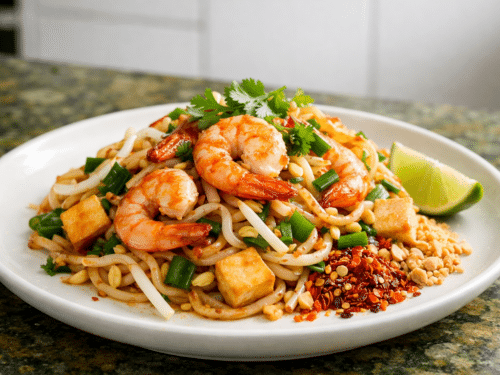
Keto Thai Pad Thai with Prawns
Print PinIngredients
Main Ingredients
- 250 g large raw prawns peeled and deveined
- 2 large eggs
- 200 g shirataki noodles rinsed and drained
- 2 tbsp fish sauce
- 1 tbsp unsweetened tamarind paste
- 1.5 1bsp powdered erythritol
- 2 cloves garlic finely minced
- 1 tbsp coconut oil (or avocado oil)
- 30 g roasted peanuts crushed
- 1 cup fresh bean sprouts
- 2 tbsp chopped garlic chives
- ⅓ tbsp chili flakes adjust to taste)
- 1 lime
- 50 g firm tofu cubed and pan-fried
Instructions
- Prepare the noodles. If using shirataki, rinse under cold water for 2–3 minutes. Then dry-fry in a hot pan for 3–4 minutes until excess moisture evaporates. They should feel slightly firmer and no longer watery. If you smell anything unpleasant, rinse again.Replacement: If using courgette noodles, lightly salt and pat dry to remove excess moisture.
- Mix the sauce.Combine fish sauce, tamarind paste, and erythritol. Stir until dissolved. Taste it now. It should be salty, tangy, gently sweet — never dominant in sweetness.
- Cook the prawns.Heat oil in a wok over medium-high heat. Add garlic. When fragrant but not browned, add prawns. Cook just until pink and slightly curled (about 1–2 minutes per side). Remove immediately to prevent overcooking.
- Cook the tofu.Pan-fry separately until golden on the edges. Set aside.
- Scramble the eggs.Lower heat slightly. Add eggs to the wok and gently scramble until just set but still soft.
- Combine noodles and sauce.Add noodles to the wok. Pour in the sauce. Toss over medium-high heat for 1–2 minutes until the sauce lightly reduces and coats the noodles.You should see the noodles absorb flavor and the sauce lightly cling — not pool.
- Return prawns and tofu.Add prawns (and tofu if using) back into the pan. Toss briefly to heat through.
- Finish with fresh elements.Turn off heat. Fold in bean sprouts and garlic chives so they remain crisp.
- Rest briefly.Let the dish sit for about 3 minutes before serving to allow flavors to settle.
- Plate and adjust.Top with crushed peanuts, chilli flakes, and a squeeze of fresh lime before eating.Taste, Too sour? Add a tiny pinch more erythritol.Too salty? Add a tablespoon of water and toss over the heat briefly.Too flat? Add more lime — not more sweetener.
Notes
Make It a Little More Special
If you want your Pad Thai to taste closer to the ones from a real Thai street cart, there are two small additions that make a quiet difference. Not dramatic. Just deeper.
Small dried shrimp – 1 tbsp
This is very common in Thailand. It gives that subtle, slightly salty depth that you don’t immediately notice — but if it’s missing, something feels flat. Add it together with the garlic at the very beginning and let it toast gently in the oil. You’ll smell it bloom after a few seconds. That’s when you know it’s right.
Shallot – 1 small bulb, thinly sliced
Shallots add a soft, natural sweetness underneath the sauce. They do contain a little carb, so if you’re keeping things very strict, use a modest amount. Sauté them with the garlic before adding the prawns. They should turn translucent and fragrant, not browned.
These two ingredients don’t overpower the dish. They just make it feel more complete — more like someone who grew up eating Pad Thai made it, not just someone copying a recipe.
Europe Ingredient Notes & Substitution Guide
- Fish sauce: Squid Brand, Tiparos, or Thai Taste are widely available in Tesco, Albert Heijn, Edeka and Carrefour. Check that no sugar is added.
- Tamarind paste: Look for pure tamarind pulp or paste. Avoid versions with added sugar or syrup.
- Shirataki noodles: Often labelled “konjac noodles” in EU supermarkets. Choose plain versions without added starch. Otherwise, use 1 medium spiralised courgette/person. Konjac absorbs sauce better and keeps carbs lowest. Zucchini is fresher but slightly higher in carbs and releases water.
- Garlic chives: If unavailable, substitute with spring onion greens — not identical, but close enough.
- Coconut oil vs neutral oil:
Coconut oil gives a subtle Thai aroma. Avocado oil works if you prefer a neutral flavour. - Tofu selection:
Choose firm tofu without added starch. Press before frying to improve texture. - Sweetener choice:
Powdered erythritol dissolves better than granulated, and avoid maltodextrin-based blends.
Common Mistakes
- Using too much sweetener. Pad Thai should not taste like dessert.
- Skipping the dry-fry step for shirataki — texture becomes watery.
- Overcooking prawns until rubbery.
- Using bottled Pad Thai sauce (almost always contains sugar or syrup).
Nutrition Estimate (Per Serving)
Approximate values (using shirataki noodles):
Calories: 510 kcal
Carbohydrates: 13 g
Fiber: 6 g
Sugar: 3 g
Net Carbs: 7 g
Protein: 42 g
Fat: 36 g
Values are estimates and depend on noodle type and peanut quantity.
Thai Kitchen Wisdom
Sweetness in Thai food is structural — it rounds acidity and salt. It should never dominate.
Acidity from lime sharpens the richness of egg and peanuts.
Salt enhances chili heat. Without enough salt, spice feels dull.
Let the finished Pad Thai rest for 2–3 minutes before eating. The sauce settles and flavors integrate better.
Storage
Store without fresh toppings.
Keeps 1–2 days in refrigerator.
Reheat gently in a pan, not microwave if possible. Add fresh lime and sprouts after reheating.
Prawns are best fresh. This dish is not ideal for long meal prep.
Tools That Matter
Carbon Steel Wok
High heat creates slight smokiness, which replaces some of the depth usually supported by sugar.
Mortar & Pestle
Crushing peanuts fresh releases aroma and oil — completely different from pre-ground.
Digital Kitchen Scale
Helps control sweetener and peanuts, preventing accidental carb creep.
|
🍰 KETO AFTER 50 DESSERTS
Eat Dessert.
Stay in Ketosis. 100+ recipes · 2 FREE bonus books · Built for over 50
|
Get It for $9 →
*affiliate link
|