
Working out your keto macros is where most people get stuck — not the ratio everyone talks about, but the amount underneath it.
There is a question I get asked constantly, usually phrased some other way: am I doing this right?
The person asking has normally read a dozen articles about keto ratios. They know fat should be most of it. They have possibly downloaded an app. And they are still not sure whether the plate in front of them is correct, because nobody ever told them the other half of the answer.
Keto has two separate questions, and almost every article only answers one.
How much you eat. And how it splits.
The ratio is the famous part. The amount is the part that decides whether it works.
Start with how much, not what percentage
Your body burns a certain number of calories just existing — breathing, pumping blood, keeping you at temperature. That is your basal metabolic rate, and there is a standard equation dietitians use for it, called Mifflin-St Jeor:
Women: (10 × weight in kg) + (6.25 × height in cm) − (5 × age) − 161
Men: the same, but + 5 instead of − 161
Then multiply by how much you move:
| How you spend your day | Multiply by |
|---|---|
| Mostly sitting — desk work, under 5,000 steps | × 1.2 |
| Some walking, housework, light exercise 1–3 days a week | × 1.375 |
| On your feet all day, or exercise 3–5 days a week | × 1.55 |
A 60kg woman of 162cm and 55 years who works at a desk: her BMR is about 1,176, and multiplied by 1.2 that is roughly 1,400 calories a day.
An 80kg man of 175cm doing physical work: BMR about 1,624, multiplied by 1.55, roughly 2,500 calories a day.
Hold onto those two people. They are about to make the whole thing obvious.
Now the split — and only one of the three actually moves
Here is where the standard advice about keto macros does real damage. You have probably seen keto described as something like 70% fat, 25% protein, 5% carbs. Those numbers are not wrong exactly, but treating all three as percentages is the wrong tool, and it is why people follow the ratio and still stall.
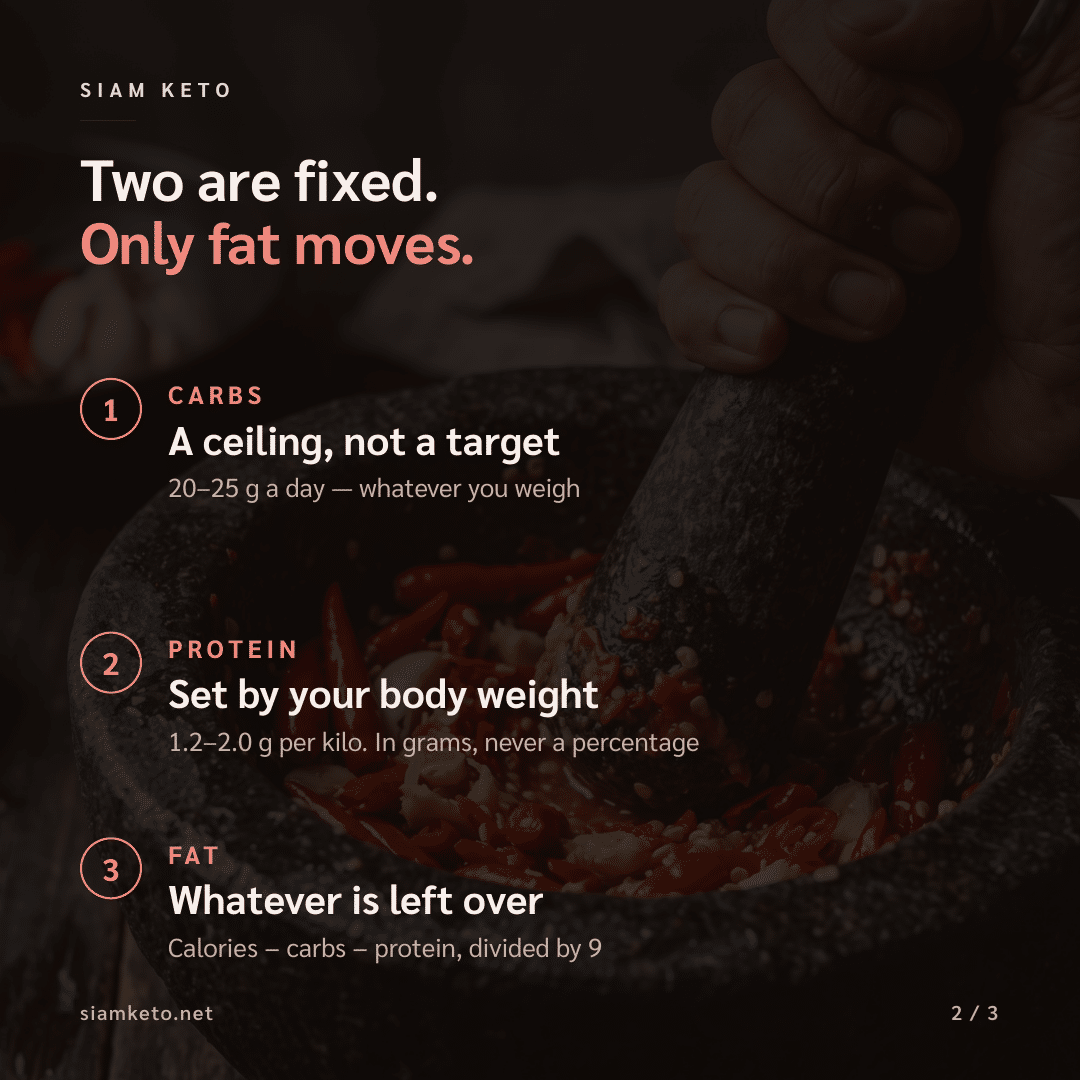
Carbs are a ceiling, not a target. Twenty to twenty-five grams of net carbs a day. That number does not change with your body size. A 50kg woman and a 90kg man get the same allowance, because what you are managing is an insulin response, not a proportion of a plate. You are not trying to reach 20 grams. You are trying not to pass it.
Protein is set by your body weight, in grams. Between 1.2 and 2.0 grams per kilo of body weight, with 1.5 as a sensible middle for most people. Note that this is in grams, not as a percentage — and that distinction matters more than it sounds. Your protein requirement stays roughly constant whether you are eating 1,400 calories or 2,500. Express it as a percentage and it appears to change when it hasn’t.
Fat is everything left over. Take your daily calories, subtract what the carbs and protein account for, divide the remainder by nine. That is your fat.
Why nine? Because a gram of carbohydrate gives you about four calories, a gram of protein about four, and a gram of fat about nine. Fat carries more than twice the energy per gram — which is exactly why a keto plate can look small and still keep you full until evening.
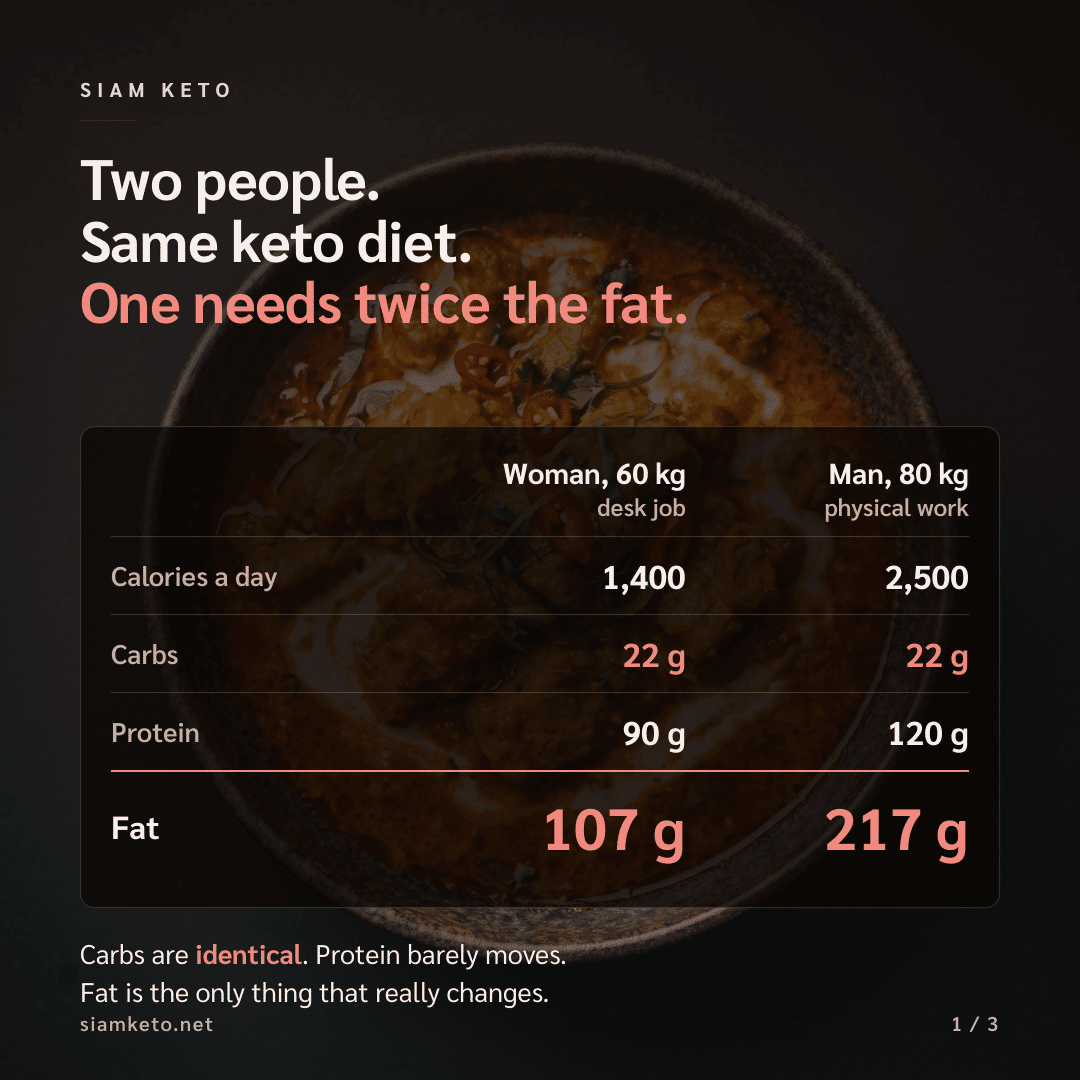
The two people, side by side
Same diet. Same rules. Both properly in ketosis.
| Woman, 60kg, desk job | Man, 80kg, physical work | |
|---|---|---|
| Calories a day | 1,400 | 2,500 |
| Net carbs | 22 g | 22 g |
| Protein | 90 g | 120 g |
| Fat | 107 g | 217 g |
The carbs are identical. The protein differs, but only in proportion to body weight. And the fat doubles.
That is the whole thing. Fat is not a target you hit. It is the dial you turn.
Once you see it this way, a lot of confusion dissolves. Someone who is hungry on keto usually does not need another meal — they need more fat in the meal they already ate. Someone who has stalled is often eating a low-carb diet rather than a ketogenic one, which brings me to the mistake I see most.
Low carb and keto are not the same thing
I was recently teaching two cooks to prepare keto food for guests at a wellness retreat, and this was the idea that took longest to land.
Take one dish from that menu: grilled sea bass with Thai herb butter. Six grams of net carbs for the whole plate, and 62% of its calories coming from fat. That is properly ketogenic.
Now take the butter out. Twenty-five grams of it, which yields about twenty grams of actual fat.
The carbs do not change. Not by a single gram. But the dish falls to 39% fat — and it is no longer a ketogenic meal. Same fish, same broccoli, same herbs, same carb count on the label, and it will not do the job.
This is why counting carbs alone is not enough. If you are tracking one number, track carbs. If you can track two, track carbs and the fat percentage. Under 60% of calories from fat and you are eating low carb, which is a perfectly reasonable thing to do — but it isn’t keto.
What changes when the food is Thai
Most keto guidance is written around Western food, and it quietly assumes a Western pantry. Thai cooking breaks a few of those assumptions.
The sauces are where the sugar hides. A tablespoon of ordinary oyster sauce carries five to seven grams of carbohydrate. Sweet dark soy is largely sugar. Sweet chilli sauce is ten to twelve grams a tablespoon and almost all of it sugar. You can use a whole day’s allowance seasoning a single stir-fry without ever seeing a grain of it. Sugar-free versions of all three exist and are worth buying — see our full rundown of hidden sugar in Thai sauces for the brands to watch.
The fruit is a genuine trap. Thai fruit is dramatically sweeter than European fruit, and a welcome platter is often the first thing a guest is handed. Per 100 grams: mango is about 13 grams of net carbs, longan 15, lychee 15, banana 20, durian 23. Under eight grams and you are fine — avocado, strawberry, young coconut, watermelon, cantaloupe, papaya. Above twelve, treat it as dessert.
But most of a Thai kitchen is already keto, and this surprises people. Fish sauce, coconut milk, every oil, lard, all the herbs, almost every vegetable in the market, and all the protein — none of it needs a special version and none of it costs more. Morning glory is one gram of net carbs per hundred. Daikon is 2.5, against green papaya’s seven, which is why a som tam made with daikon tastes close to the original and costs you almost nothing.
Only two categories genuinely need replacing: sauces the manufacturer sweetened, and flour.
Four things worth doing
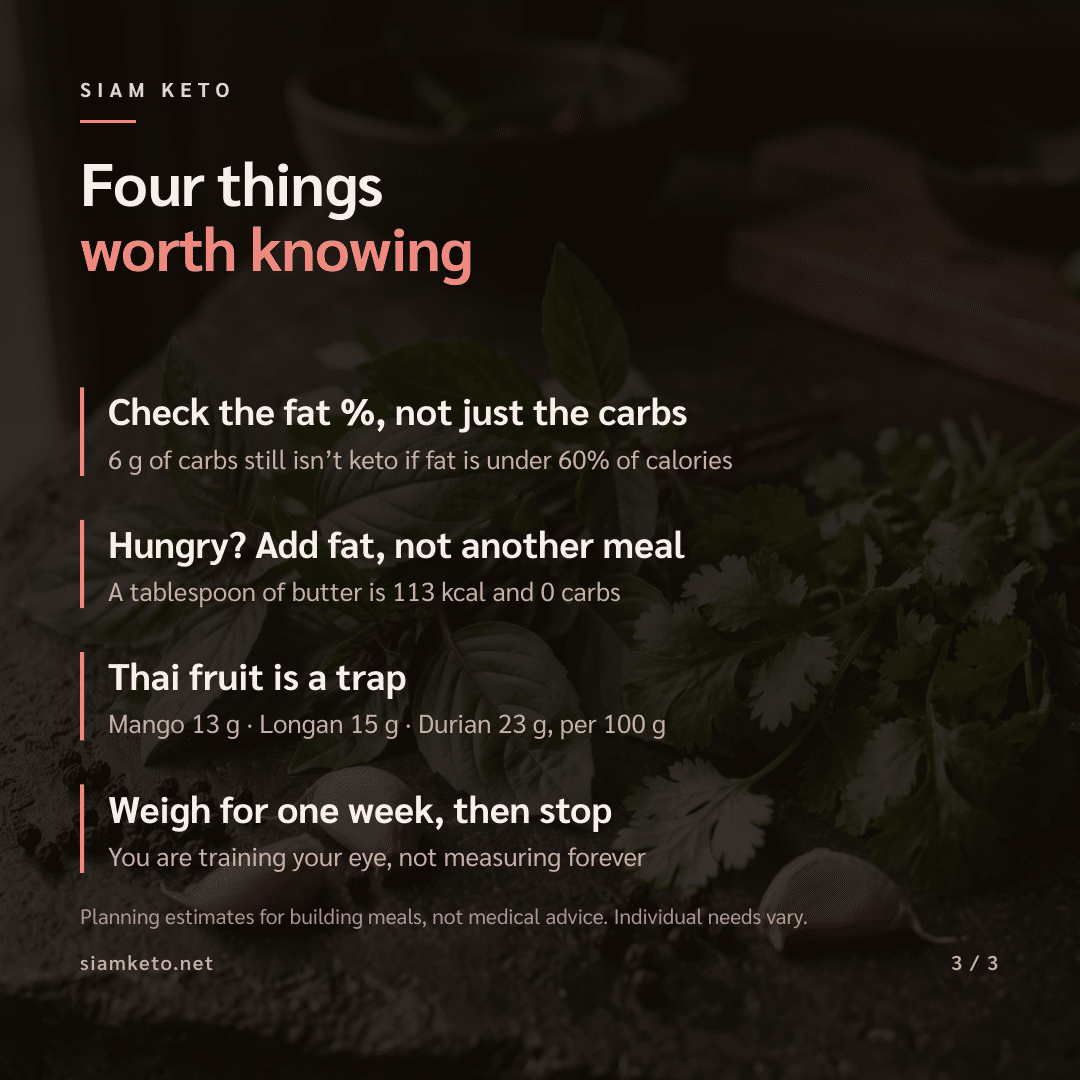
Check the fat percentage, not only the carb count. Six grams of carbs is not keto if the fat never arrived.
When you are hungry, add fat rather than another meal. A tablespoon of butter is 113 calories and moves your carbs by nothing at all.
Weigh things for one week, then stop. You are not measuring for the rest of your life. You are training your eye so that you can look at a plate and know.
Write your three numbers down once. Your carb ceiling, your protein in grams, and your fat. Stick them inside a kitchen cupboard. Recalculate if your weight changes by more than about five kilos. Those three numbers are your keto macros — nothing more mysterious than that.
Where to start with your keto macros
Work out your keto macros with the equation above. Set your carbs at 20–25 grams and your protein at 1.5 grams per kilo. Whatever calories remain, divide by nine — that is your fat, and it is the number you adjust when you are hungry, when you are stalling, or when your week gets more active.
Then cook something you actually want to eat. That part matters more than the arithmetic.
These are planning estimates for building meals, not medical advice, and individual requirements vary. If you have a medical condition or take medication — particularly for diabetes or blood pressure — speak to your doctor before making a significant change to how you eat.